
Nigerian Newspapers
An Iron Lady’s pragmatic relations with Nigeria

Like her or hate her – and opinion may vary about her – Margaret Thatcher’s place in British history is assured as one of the most controversial, if not greatest, prime ministers the country has ever had – the greatest perhaps since Winston Churchill.
How ironic that it was an African country, Nigeria, that taught her first bitter lesson in foreign affairs when she became Prime Minister in 1979. It was at the height of Nigeria’s “dynamic foreign policy” when, demonstrating that it was truly “The Giant of Africa”, it took everyone unawares and surprisingly nationalised the Nigerian assets of British Petroleum (BP) and paid every dime of the worth of the international oil company in Nigeria back to its Brittanic House headquarters in the city of London. As if to thumb its finger on the eye of its former colonial master, Nigeria renamed British Petroleum as African Petroleum (AP).
The British establishment reacted with astonishment.
It was a deliberate move by General Olusegun Obasanjo, the Head of State then, to punish Britain for breaking United Nations (UN) sanctions to supply oil to apartheid South Africa – although the true reason for the action was to force Thatcher, famous then as “the Lady who is not for turning” to reach a compromise on the issue of Rhodesia/Zimbabwe.
Nigeria’s BP masterstroke came unexpectedly on the eve of the Commonwealth Summit in Lusaka, Zambia. The Iron Lady was so dazed, wrong footed and embarrassed as the news from Nigeria filtered through the garden of the presidential villa in Lusaka where a reception was going on for visiting Heads of Government.
UK’s Foreign Secretary, ever so pleasant, usually a very well polished technocrat and highly respected, Lord Carrington, did not know when he lost his diplomatic calm as he approached Nigeria’s External Affairs Minister, Major-General Henry Adefope, who was the leader of the Nigerian delegation, and swore that UK would make Nigeria regret the action. Prior to the nationalisation of BP, the view of Nigeria at No. 10 Downing Street was that it could “only bark but not bite”.
That move by General Obasanjo set the tone for Anglo-Nigerian relations in the late ’70s and up to the early and mid ’80s. Things were so bad then between both counties, so much so that it was under Thatcher’s premiership that Nigeria even broke her diplomatic ties with the UK over the issue of the kidnapping in broad day light on London streets of former Nigerian Transport Minister Umaru Dikko.
But due credit must be given to Mrs Thatcher that she later on mended fences with Nigeria, struck a good pragmatic partnership with President Babangida whom she famously described on seizing power from General Buhari as “a man we can do business with”. She lived up to that statement by visiting Nigeria not once but twice when Babangida was president. In one of the visits she came with her husband, Denis. It is important to note that Nigeria was the only African country she officially visited twice as British prime minister. And that speaks volume. For someone who as British Prime Minister was not really a friend of Africa, her coming to Nigeria twice despite the frequent diplomatic rows between the two countries showed the esteem with which she later held Nigeria. Not only that, under her premiership she increased the number of Nigerian students admitted into British universities on British scholarship under a scheme administered then by her education secretary Dr. Rhode Boyson because statistics had shown that Nigerian students had consistently outperformed their peers from the rest of the world. Shortly before this, she had in a year when Nigeria’s total spend on student on government scholarship in the UK was about £80milllion, jacked up school fees for foreign students. It was an unpopular move that made countries like Nigeria and Malaysia affected by it to consider cheaper climes like America to send the bulk of their students to. Britain’s loss was thus America’s gain.
Again Thatcher came head-to-head with Nigeria when a new Commonwealth Secretary-General was to be elected. She had pitched her tent in support of Malcolm Fraser, the former Australian prime minister, who was the opponent of Nigerian Chief Emeka Anyaoku. To be fair to her on this particular occasion, it was not Thatcher’s fault that she was against the Nigerian candidate. Chief Anyaoku, who was then deputy secretary-general, entered the race very late – long after Fraser had almost completed his campaign tour of the Commonwealth seeking support. Interestingly, Thatcher was not the only key ally of Nigeria who was against Anyaoku, even President Kenneth Kaunda of Zambia was in support of Fraser based on principle that the former Australian premier had been to him first to seek his and Zambia’s support at the election and he had been given his word to the affirmative before Anyaoku came calling.
And, by the way, if Anyaoku had not decided to contest Nigeria too would have backed Fraser in appreciation of his unflinching support to Nigeria and Africa’s stance on issues of Rhodesia and South Africa when he was premier of Australia. Chief Anyaoku, had done the honourable thing by waiting patiently to get the nod from his boss, Sir Shridath Ramphal, that he would not contest for another term before putting his hat in the ring. In the end, however, it did not matter anymore as Nigeria succeeded in getting enough support for Anyaoku who was elected the first African Secretary-General of the Commonwealth despite Thatcher’s and Kaunda’s support for Fraser. And finally, it must be said: Mrs. Thatcher was again surprisingly generous in her praise of Nigeria in her memoirs in which she described Nigeria as a very complex country to rule.
In Britain she will be remembered for her social and economic reforms (most especially her controversial poll tax) considered by many Britons to be inhuman – left to her, the social security system of the welfare state would have been scrapped because she did not believe that “the state should do it all” for its citizens. On this her position she was considered too insensitive. Don’t forget that she was also the notorious “Margaret Thatcher the milk snatcher” – reference to her stopping the distribution of free milk at school when she was education secretary. Besides, she will also be remembered for taking on the powerful trade unions and breaking their influence for good. In Europe she will be remembered as the British prime minister who was always the odd man out and ensured that the UK did not join the single currency – the Euro, and the exchange rate mechanism. And in the world, Margaret Thatcher will be remembered for taking Britain to war against Argentina in far away Falkland Island; for her unflinching support for Ian Smith in Rhodesia and P. W. Botha in apartheid South Africa.
May her soul rest in peace.
•Soyinka, publisher, The Africa Today, wrote from London.
————————————————————————————————————————-
Posted in Nigerian Newspapers. A DisNaija.Com network.
Source: The Nation Newspaper
DisNaija.Com publishes regular posts on Nigeria News, Nigerian Newspapers, Online Nigeria Gist.
Follow us on Twitter and Facebook.
Your Opinion Counts. Be sure To Leave A Comment, If You Have Any.
Please Like, Share or Tweet. Your Support Is Appreciated.



•Deploy more personnel as army chief vows to wipe out terror group
•Security beefed up at N’Assembly
Deji Elumoye and Kingsley Nwezeh in Abuja
Abuja, Nigeria’s seat of power, is under a massive security cordon following threats of attacks by insurgents and the increasing wave of banditry in the contiguous states of Kaduna, Kogi, Nasarawa and Niger States, THISDAY’s investigation has revealed.
There has been a wave of kidnappings in the outskirts of the federal capital, notably Pegi, Tuganmaje and Kuje among others, which the police have battled in recent times.
The security situation in and around the Federal Capital Territory (FCT) was heightened by the pronouncement of the Niger State Governor, Mr. Sani Bello, that Boko Haram fighters who he said sacked 50 villages in the state and hoisted the terror group’s flag, were about two hours drive away from the FCT.
Security has also been beefed up at the National Assembly as operatives, yesterday, thoroughly screened every vehicle approaching the National Assembly complex in Abuja.
The deteriorating security situation nationwide prompted the National Chairman of the Peoples Democratic Party (PDP), Prince Uche Secondus, to warn that the 2023 general election may not hold, demanding the declaration of a state of emergency as well as the convocation of a national conference.
However, the Chief of Army Staff, Lt. Gen. Ibrahim Attahiru, yesterday restated the Nigerian Army’s determination to annihilate Boko Haram.
But the Governor of Katsina State, Hon. Bello Masari, cautioned against declaring a state of emergency, saying doing so isn’t the solution to combat the security challenges facing the country.
The security of the nation’s airports was also in focus yesterday as the Office of the National Security Adviser (ONSA) said there was no threat to them.
THISDAY’s investigations showed increased presence of troops, police, Nigerian Security and Civil Defence Corps (NSCDC) personnel and intelligence operatives at the three strategic entrances to the city notably, Keffi, Zuba and Gwagwalada.
More checkpoints were also mounted around Gwagwalada and Keffi.
THISDAY also observed increased intelligence deployment at the entrance and the borders of FCT with contiguous states.
Beyond the borders, there were more deployments and police patrols inside the city and increased intelligence deployments as well.
Security sources told THISDAY: “There are deployments here and there but they are routine. Alertness is key to a secure environment.”
It was also learnt that security agencies were involved in frenzied meetings throughout yesterday.
The meetings, coordinated by the office of the Chief of Defence Staff under the new joint operational strategy of the armed forces, were aimed at coordinating a joint response to possible threats of attack to the FCT.
“I understand the security teams have been meeting for some days now and if you look around you, you will notice that there are increasing patrols and numbers of security personnel. The threats are not been taken lightly,” a source said.
National Assembly workers, lawmakers and visitors also had a harrowing experience accessing the legislative complex due to heightened security in the area.
Security operatives thoroughly screened every vehicle approaching the National Assembly complex in Abuja, impeding both human and vehicular traffic.
The Sergeant-at-arm of the National Assembly and other security agencies supervised the operations, leading to huge traffic build-up inside the complex.
Legislative staff, visitors and lawmakers were seen patiently waiting for their cars to be searched so that they could go ahead with the business of the day.
Some staff and visitors at some point got tired of waiting and were seen alighting from their cars to trek from the gate to the complex.
Meanwhile, the ONSA has said there is no threat to the nation’s airports.
A statement by the Head of Strategic Communication, Mr. Zachari Usman, said the reports of threats to the airports were an internal correspondence of security threat assessment misconstrued as security threat to the airports.
PDP Demands State of Emergency
In a related development, the PDP National Chairman, Prince Uche Secondus, yesterday demanded the declaration of a state of emergency, warning that the 2023 general election might not hold if the federal government failed to tackle insecurity.
He called on the federal government to summon a national conference to address the spike in insecurity.
Secondus added that the national caucus of the party will meet today to discuss the state of the nation.
Addressing members of the National Executive Committee (NEC) in Abuja, Secondus said: “We are worried Abuja is not even safe. It is no longer politics. We got alert of plots to bomb and burn down our airports.
“We urge the federal government to declare a national state of emergency in security. There is the need to call a national conference to discuss the insecurity in the country.
“There may not be any election in 2023 in Nigeria due to insecurity. This government must listen to the people. The Buhari government should call a national confab to discuss security and state of the nation. It is no longer politics. This time we are not playing politics. Let’s keep politics aside and move the nation forward.”
He said the country had been grounded, regretting that there had been no matching response from the federal government.
Secondus said in the past, terrorism in the North was confined to the North-east, but with the report of Boko Haram occupying villages in Niger State, terrorism had spread to the North-central
“Herdsmen are also menacing in the West; gunmen causing havoc in the East; and the militants in the South; all killing, looting, raping, maiming and burning down homes. The situation is bad; Nigerians all over are living in fear,” he said.
The Senate Minority Leader, Senator Enyinnaya Abaribe, said the problem of Nigeria was outside of the PDP headquarters, while pledging the support of the Senate to the declaration of state of emergency in security.
Abaribe said he deliberately decided not to speak on the floor of the Senate but to allow the APC senators to speak so as to avoid being accused of giving a partisan colouration to the issue of insecurity.
He stated that only electoral reforms would give victory to the opposition party in the 2023 general election and ensure a democratic defeat of the APC-led federal government.
Also, the Minority Leader of the House of Representatives, Hon. Ndudi Elumelu, commended the NEC and the PDP leadership for their collective efforts at resolving the House leadership crisis.
The NEC meeting adopted the position of Secondus, calling on the federal government to convoke a national conference to discuss the state of insecurity in the country, according to a communiqué read by the National Publicity Secretary, Mr. Kola Ologbondiyan.
Army Chief Vows to Wipe Out Boko Haram
The army yesterday reiterated its commitment to wipe out Boko Haram.
Chief of Army Staff (COAS), Lt. Gen. Ibrahim Attahiru, told reporters in Maiduguri, Borno State that Boko Haram had been defeated in many encounters and would continue to be defeated until it’s annihilated from Nigeria.
“We will take on Boko Haram decisively, and we are committed to the focus of the operations, which is the total annihilation of Boko Haram from Nigeria,” he said.
The COAS, who was visiting the headquarters of Operation Lafiya Dole in Maiduguri for the fifth time since his appointment four months ago, said the visit was to boost the morale of the troops, reassure them and listen to any issues affecting them.
Earlier, the Theatre Commander of Operation Lafiya Dole, Maj. Gen. Farouq Yahaya, lauded the visit, which he said had continued to boost the morale of the troops.
“We are honoured, we are grateful, we are encouraged by those visits. You provided us guidance, logistics and other things we required. We are most grateful for those visits,” Yahaya said.
State of Emergency Won’t Solve Security Challenges, Says Masari
Katsina State Governor, Hon. Aminu Masari, has, however, said declaration of a state of emergency won’t solve the security challenges facing the nation.
Masari, who spoke yesterday with journalists after meeting with the Chief of Staff to the President, Prof. Ibrahim Gambari at the State House, Abuja stated that he was against the recent call by the House of Representatives for the declaration of a state of emergency in the security sector as it would not solve the problem.
According to him, declaring a state of emergency will not achieve the desired effect as the security structure and personnel to be used to execute the emergency are already overstretched in a bid to safeguard lives and property.
Sourced From: THISDAYLIVE
Tribune Online
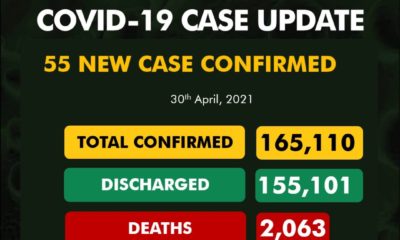
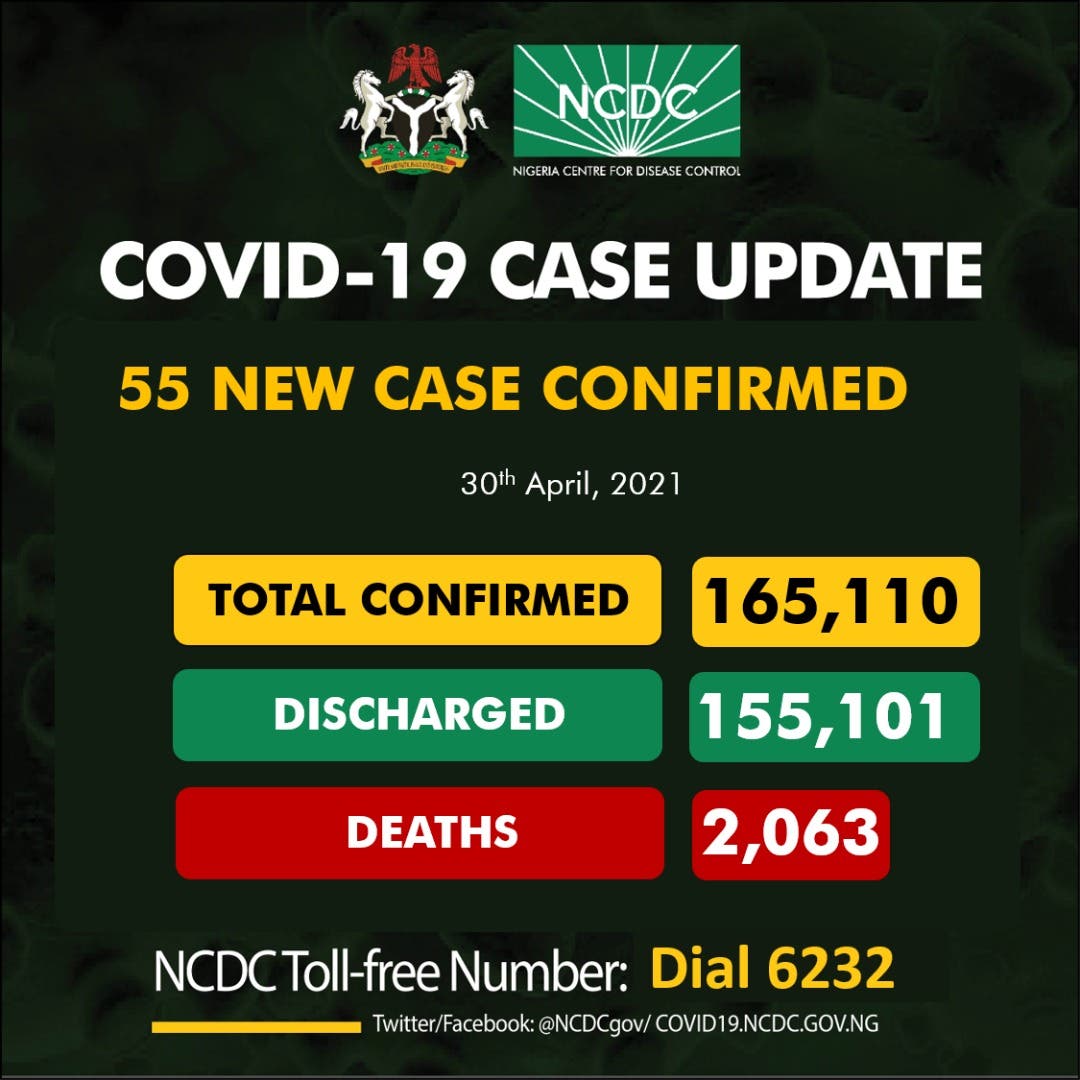
Nigeria records 55 new COVID-19 infections, total now 165,110
The Nigeria Centre for Disease Control (NCDC) has recorded 62 new cases of COVID-19, bringing the total number of infections in the country to 165,110. The NCDC disclosed this on its official Twitter handle on Friday. “55 new cases of #COVID19Nigeria; Lagos-21, Yobe-19, Ogun-6, Akwa Ibom-3, Kaduna-2, Plateau-2, FCT-1, Rivers-1.” YOU SHOULD NOT MISS THESE HEADLINES FROM NIGERIAN TRIBUNE COVID-19: Nigeria Recorded […]
Nigeria records 55 new COVID-19 infections, total now 165,110
Tribune Online
Sourced From: Tribune Online
The government said that no worker should stay back beyond 6:00 p.m. within premises of buildings undergoing construction.
The post Insecurity: Lagos bans occupation of abandoned buildings appeared first on Premium Times Nigeria.
Sourced From: Premium Times Nigeria
Kamaru Usman has raked in a mammoth £1.1million, about N584.2 million after his impressive knockout victory over Jorge Masvidal on Saturday night, Sportivation.com.ng reports.
The Nigerian Nightmare has been handsomely rewarded for his stunning performance and he was the best-paid fighter on the card which was witnessed by 15, 000 fans in Florida.
According to Daily Mail, Usman earned £538,000 to show up, £459,000 pay-per-view bonus, a £43,000 sponsorship bonus and a well deserved £35,000 Performance of the Night bonus.
Jorge Masvidal also earned £358,000 to show, £186,000 in pay-per-view money and a £28,000 sponsorship bonus.
This is the biggest payday of Usman’s career so far and the Welterweight champion also benefited from the fact that Masvidal is also a top draw for the fans.
Kamaru Usman is a Nigerian-American professional mixed martial artist, former freestyle wrestler and graduated folkstyle wrestler.
Sourced From: Latest Nigeria News, Nigerian Newspapers, Politics

Nigeria records 55 new COVID-19 infections, total now 165,110
Military, Police Ring Abuja to Forestall Boko Haram Attack
UFC: Usman gets N584m after beating Masvidal
Insecurity: Lagos bans occupation of abandoned buildings



Buhari Will Win In 2019: US Institute
The United States Institute of Peace (USIP) has predicted that President Muhammadu Buhari will win the 2019 election. The organisation...

Why Buhari Deserves Second Term – Lai Mohammed
The Minister of Information and Culture, Alhaji Lai Mohammed has said that President Muhammadu Buhari deserved second term election because,...

Atiku Presidential Campaign Council: PDP Releases List of Members
The Peoples Democratic Party (PDP) on Tuesday released the list of party members to handle the campaign team of the...
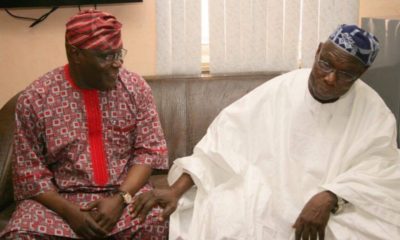

Obasanjo Forgives Atiku, Endorses Him For President
Former President Olusegun Obasanjo on Thursday said he has reviewed his stance on not backing his former deputy for the...
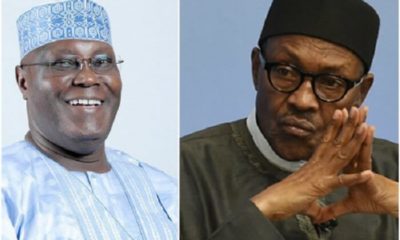

Buhari, Atiku In Battle Of Integrity Over 2019 Poll
THE brickbats continued yesterday between President Muhammadu Buhari and former Vice President Atiku Abubakar. The All Progressives Congress (APC) and...